
Using Your Time for Improved Well-Being


Feel like you never have the time to do the things you want and barely have time to do the things you need to? How much discretionary time do you need to feel happier and more satisfied with life?
The answer may surprise you.
People with fewer than two hours of discretionary time per day tend to report lower levels of happiness and life satisfaction. But more free time isn’t automatically better. People with more than five hours of discretionary time also can report lower happiness levels than those with less discretionary time.
A rough ball park figure tends to be somewhere between two and five hours a day of discretionary time.
Researchers have found that what may matter most is not simply how much time we have, but how intentionally we spend it.
Intriguingly, making time for meaningful or enjoyable activities can actually make us feel like we have more time overall. In other words, when life includes moments of joy, connection, or purpose, time expands psychologically.
Although we can’t create more hours in the day, we can become more deliberate about how we spend the hours we do have.
Evidence-Based Strategies to Use Time More Intentionally for Improved Well-Being
1. Time “bundling”
Pairing a necessary task with an enjoyable activity can improve motivation and satisfaction. This strategy, sometimes called “temptation bundling,” involves combining something you have to do with something you want to do.
Examples:
Folding laundry while listening to music or a favourite podcast
Walking on a treadmill while watching a TV show
Meal prepping while chatting with a friend
The task itself may not change, but your experience of the time does.
2. Schedule joy first
Many people treat enjoyable activities as rewards to be earned after productivity. The problem is that the list of responsibilities rarely ends.
Research suggests that intentionally scheduling pleasurable or meaningful activities - exercise, hobbies, social connection, time outdoors - can increase feelings of time abundance and overall well-being.
3. Protect attention, not just time
Unnecessary distractions disrupt our sense of time. Even brief interruptions from notifications, emails, or multitasking can reduce focus and increase stress.
Studies on attention and productivity show that when you are focused on a task it may feel more satisfying and efficient than constantly switching tasks.
Small strategies can help:
Turn off nonessential notifications
Create short blocks of uninterrupted focus time
Put your phone in another room during meaningful activities
Resist the urge to fill every spare moment with scrolling
Sometimes reclaiming time begins with reclaiming attention.
4. Create moments of awe
Research in positive psychology suggests that experiences of awe - moments that make us feel connected to something larger than ourselves - can expand our perception of time and increase life satisfaction.
Awe does not have to involve grand adventures. It can come from:
Watching a sunset
Listening to music
Spending time in nature
Looking at art
Having a deep conversation
Watching children play
These moments slow us down psychologically and help counter the feeling that life is racing by.
5. Make time social
One of the most consistent findings in happiness research is that positive social connection is related to well-being.
Even brief interactions matter.
A coffee with a friend, a phone call, a walk with a partner, or an uninterrupted dinner conversation can provide a stronger boost to happiness than passive leisure activities done alone. Time often feels more meaningful when it is shared.
Try This:
Choose a strategy above and try it for two-weeks. Check in how you’re feeling after using the strategy. Has your mood shifted? Do you feel like you have more time?
Let me know if the strategy worked.
Ultimately, the goal may not be to squeeze more into our schedules, but to become more intentional about what deserves our time in the first place.
Reference:
Holmes, C. M., Sharif, M. A., & Hershfield, H. E. (2021). Having too little or too much time is linked to lower subjective well-being. Journal of Personality and Social Psychology, 121(4), 933–947. https://doi.org/10.1037/pspp0000391
Professor Pozzulo’s Pick
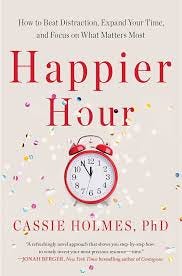
For a deeper dive, I recommend Happier Hour: How to Beat Distraction, Expand Your Time, and Focus on What Matters Most by Cassie Holmes, Ph.D. (2022) - a practical, evidence-based book to help you use your time more intentionally for improved well-being.
Happy reading,
Dr. Pozzulo
-When we read, we feel better